
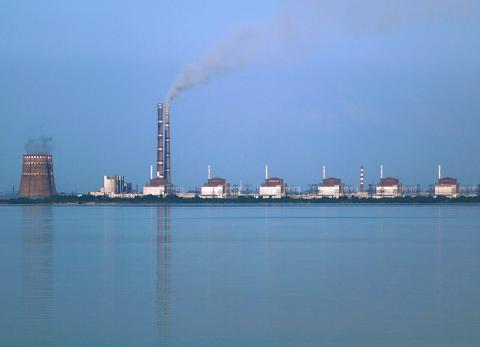
A First in History
The seizure of the Zaporizhzhia Nuclear Power Plant (ZNPP) by russian forces in 2022 marked the first time in history that an active nuclear facility was taken over during an armed conflict. As of 2025, all six reactors remain in cold shutdown. While this reduces the immediate threat of meltdown, the long-term risks remain severe — not only for Ukraine, but for the entire world.
Nuclear Infrastructure in a War Zone
The Zaporizhzhia plant is Europe’s largest nuclear power station and one of the top ten in the world. Designed for civilian energy generation, it requires constant technical oversight, an uninterrupted power supply, and professional, independent staff.
By militarizing the site, russia has:
- Turned a civilian energy facility into a military base
- Deployed troops and weapons near reactors and spent fuel storage
- Intimidated and restricted Ukrainian staff working under occupation
- Blocked full and safe access by international inspectors
This is a violation of the Geneva Conventions, the IAEA safety standards, and multiple principles of international humanitarian law.
Why the Whole World Should Worry
1. Risk of a Nuclear Accident
Even in cold shutdown, the reactors and spent fuel pools require active cooling to prevent overheating. Loss of external power or cooling — due to sabotage, shelling, or mismanagement — could lead to a nuclear incident. This scenario is not theoretical; similar failures caused the meltdown at Fukushima in 2011.
2. Radiation Could Cross Borders
Radioactive particles, once released into the atmosphere, do not recognize borders. Depending on wind patterns and weather, fallout could reach not only neighboring countries like Poland, Romania, and Moldova — but also move across Europe, contaminating soil, water, food chains, and ecosystems for decades.
3. Precedent for Nuclear Hostage-Taking
russia’s occupation has set a dangerous precedent: that nuclear infrastructure can be used as leverage in war. If left unpunished, this tactic may inspire similar acts in future conflicts — turning peaceful nuclear facilities into strategic targets worldwide.
4. Collapse of Nuclear Safety Norms
The global nuclear system is based on transparency, international oversight, and shared responsibility. russia has repeatedly obstructed the work of the International Atomic Energy Agency (IAEA), limiting access, tampering with sensors, and creating a false sense of stability. This weakens global trust in the international nuclear safety regime.
Could the Ocean Protect the United States?
Many assume that the United States is safe from any fallout related to the Zaporizhzhia Nuclear Power Plant due to the Atlantic Ocean. While the vast distance does offer some protection, it is not an impenetrable shield.
Geographic Distance Helps — But Doesn’t Guarantee Safety
- Distance matters: The Zaporizhzhia plant is over 8,000 kilometers (5,000 miles) from the continental United States.
- Atmospheric dilution: Radioactive particles weaken and disperse as they travel, especially over oceans.
- Ocean as a buffer: Particles can be absorbed or diluted in the water, reducing the risk of direct contamination reaching American shores.
Still, the U.S. Is Not Entirely Immune
- Global environmental consequences
A major nuclear accident could affect:- the ozone layer,
- atmospheric circulation,
- agricultural ecosystems worldwide.
- Trans-oceanic radiation transport
After the Fukushima disaster in 2011, trace levels of radioactive isotopes were detected off the west coast of the U.S. — not dangerous, but proof that long-range spread is possible. - Economic and political fallout
- A radioactive disaster in Ukraine would disrupt global food markets (especially wheat and corn exports).
- It could cause massive displacement, humanitarian crises, and new geopolitical conflicts.
- The United States would likely be drawn into the global response — diplomatically, economically, and possibly militarily.
Conclusion
The Atlantic Ocean offers time and distance, but not full immunity. In a connected world, no country is entirely isolated from the consequences of nuclear disaster — not even the United States.
What Must Be Done
- Immediate demilitarization of the plant
All military presence must be removed. The ZNPP must never be used as a base or shield in armed conflict. - Full return to Ukrainian control
Only Energoatom — the legal, trained Ukrainian operator — can ensure safe operation and maintenance of the plant. - Unrestricted access for the IAEA
Independent inspectors must have full, permanent access to the plant and monitoring systems, without obstruction or intimidation. - International legal consequences
russia must be held accountable for violating nuclear safety norms. The occupation of a nuclear power station is a crime with global implications and must be treated as such.
Final Words
The ongoing occupation of the Zaporizhzhia Nuclear Power Plant is not just a Ukrainian tragedy — it is a global emergency waiting to happen. If the world continues to look away, the consequences could be irreversible. Nuclear safety is a shared responsibility. Protecting it starts now.


